
Governor Walz is planning to cut 100% of the funds for non-public student aid and transportation that have been a standard part of our education system since 1975. Until now, Minnesota has always allotted funds for private schools to provide part-time school nurses and guidance counselors as well as non-religious textbooks and transportation. The cuts amount to as much as 10% of some private schools’ operating budgets.
Locally, in my hometown of Fergus Falls, MN, Hillcrest Lutheran Academy has 355 students enrolled in Pre-K through 12th grade. The proposed cuts would remove $125,340 which the school currently uses for a school nurse, guidance counselor and textbooks. Hillcrest does not use the public funds available for transportation. (I also reached out to our Pre-K-6 Catholic school, but did not get the numbers back in time for this post).
A number of private school educators testified before the Minnesota Committee on Education Finance on February 5th, 2025. Andrew Hilliker, President of Stella Maris Catholic Academy shared a story that is important for everyone to hear.
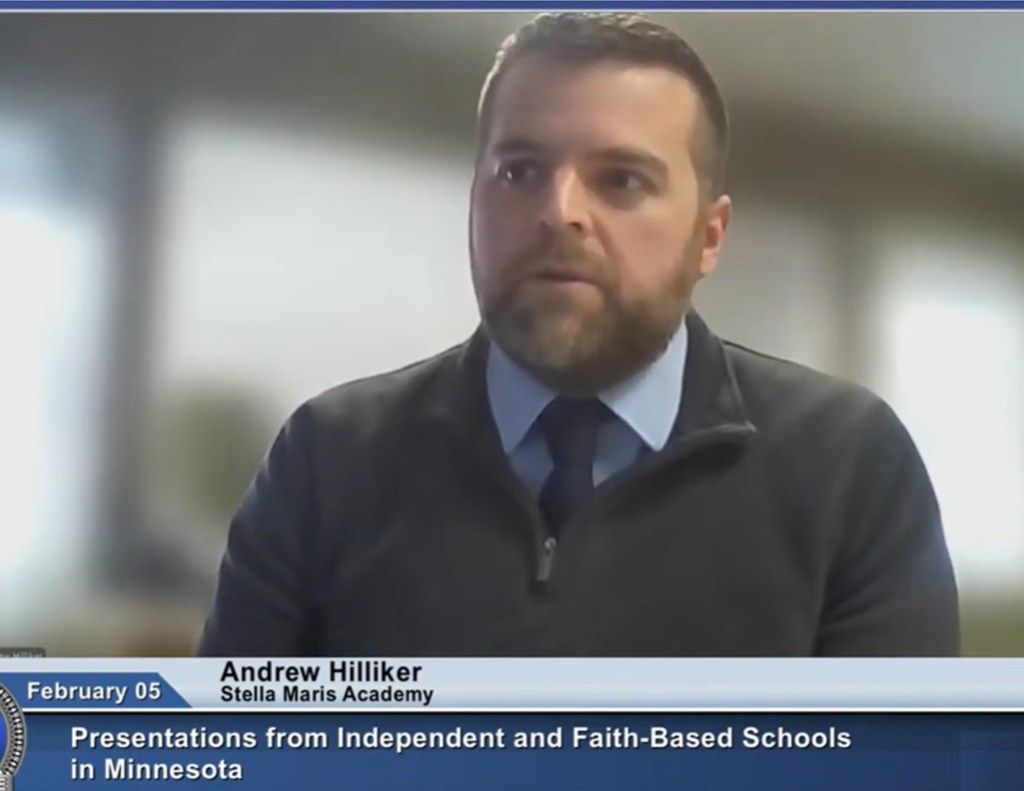
“When I came into…Catholic School leadership about…8 years ago, I attended an informational training session hosted by the Minnesota Department of Education. And as a newer independent school leader, I was impressed with the welcome message from the individual that provided that training. She started out by saying, ‘We are the Minnesota Department of Education,’ and she went on to say that, ‘The title of our department is very important, because it is not the Minnesota Department of Public Education. [We] are positioned and prepared to support all students for the essential needs for them to be successful across Minnesota regardless of where their families choose to send them to school.’”
That was just eight years ago. What happened to the open-hearted mindset in which we used to value and support a wide diversity of education options? All taxpayers contribute to the state’s education fund. Those who choose private schools only see a small amount of their contribution come back to them in the form of non-public student supports. These funds are the most vital to private schools that are providing education options in low-income neighborhoods. In these areas, families are not able to provide the needed funds through higher tuition.
In researching this issue, I was very encouraged to be given a glimpse into a quiet but mighty side of Minnesota that you may not see featured in the news.
Some of the administrators who testified represent schools that are in the heart of metro neighborhoods where local public schools are struggling with dismal outcomes. But each of these schools shine a light of hope, offering education that works and a bright future to hundreds of children in vulnerable situations.

Quentin Moore, the Vice President of Advancement for Ascension Catholic Academy, was one of several people who testified on February 5th.
Quentin shared that his school operates four Pre-K-8 schools in Minneapolis and St. Paul neighborhoods. Ninety-six percent of those enrolled are students of color. Sixty-eight percent qualify for free and reduced meals. Forty-five percent identify as Catholic. Seventeen-percent are English Language Learners. Yet ACA students consistently outperform neighboring public schools even though the demographics are the same. Three quarters of ACA students maintain consistent attendance. And since 2016, nearly 100% of the school’s 8th graders have gone on to graduate from high school in four years.
Wow. Put these people in charge of Minnesota’s public schools, please!
Beyond these remarkable statistics, ACA successfully educates their students at half the cost of public schools. What do they have that the public schools do not?
I reached out to Mr. Moore with these questions and I would like to share with you his answers because they provide a vision for what is needed for all children to thrive.
In an email, Mr. Moore wrote, “I believe ACA’s success stems from our strong foundation in Catholic social teaching, which encourages scholars to see themselves as beloved children of God. Our consistent emphasis on fostering Christ-like character in the classroom, school, and broader community also plays a crucial role.
Additionally, our commitment to ongoing professional development ensures that our educators are equipped to engage scholars who may be behind grade level. We provide individualized instruction alongside a continuously expanding team of trauma-informed staff, creating an environment of belonging and safety.
Most importantly, in my opinion, the relationships our teachers and staff build with parents and caregivers are life changing. We prioritize not just academic achievement but also the holistic growth of each child, nurturing their values and emotional development in partnership with their families. We continue to strengthen a culture of high expectations as our families and scholars strive for prosperity and excellence”.
Could it possibly be, that teaching children that they are beloved children of God, and engaging in deeply rooted partnerships with families, can somehow accomplish what Social Emotional Learning and heavily funded public education cannot? I share Mr. Moore’s words because the seeds of this truth can be planted by anyone, in any community, starting right now, with no cost. We cannot overhaul the education system overnight. But starting today, you can look for ways to engage children in your own community with the life-changing truth that they are beloved children of God.
In the meantime, get the word out about this potential cut in funding to private schools. It is vital to the schools that are doing the most remarkable work in the most challenging settings. If your representatives do not understand the importance of non-public student funds, contact them and share your concerns. Let’s work together to make Minnesota a state that welcomes and aids education options.

 Minnesota True
Leave a comment